Government caves in and releases ministerial briefing papers hours before London elections

It has taken over three years for Simon Birkett (Founder and Director of Clean Air in London), backed by Friends of the Earth’s Rights and Justice Centre and assisted by top barristers Gerry Facenna and Laura Elizabeth John of Monckton Chambers, to win this legal fight

Ministerial papers show the Labour Government wanted to comply with air pollution laws and was looking closely at its Powers of Direction to stop Boris Johnson taking backward steps.  It was looking particularly at forcing Mayor Johnson to stop or mitigate the effects of removing the western extension of the congestion charging zone

After a legal battle lasting more than three years, Simon Birkett (as Founder and Director of Clean Air in London) has succeeded in forcing the Government to release – just hours before the London Mayoral and London Assembly elections – a fourth tranche of information that discloses finally all but three sentences of detailed ministerial briefing papers.  The First-tier Tribunal approved a Consent Order between the parties on Tuesday 1 May.

These papers relate to a meeting that took place on 22 January 2009 between Lord Hunt, Air Quality Minister of the Labour Government, and Boris Johnson to discuss air pollution in London.  Simon Birkett, backed by Friends of the Earth’s Rights and Justice Centre and assisted by top barristers Gerry Facenna and Laura Elizabeth John of Monckton Chambers, has fought for access to these papers under environmental information laws.  The case involved an appeal to the Court of Appeal on an important technical point which set valuable precedents for future requesters across the UK.

The fourth and final tranche of information released by the Department of Environment Food and Rural Affairs (Defra) shows:

  • Its release in 2009 would have contributed significantly to public understanding on an important matter of environmental protection i.e. the Mayor’s planned removal of the western extension of the congestion charging zone (WEZ).
  • The Labour Government was looking closely at its ability to use Powers of Direction under the Air Quality Standards Regulations 2007 to force Boris Johnson, as Mayor of London, to stop his planned removal of the WEZ or mitigate the impacts of doing so.  We now know that Powers of Direction to meet the UK’s national objectives [for air quality] had been applied once in the past to Birmingham City Council which refused to report to central government on local air quality and the Government’s considerations about using them again.
  • The legal duties Boris Johnson should have complied with when developing his Air Quality Strategy that was finally published in December 2010.

Note:  The UK’s reapplication on 11 May 2010 for a time extension until June 2011 to comply with legal standards for dangerous airborne particles (PM10) assumed that Phase 3 of the London low emission zone would be postponed until 2012 but not that the WEZ would be removed.

Simon Birkett’s legal team at Friends of the Earth’s Rights and Justice Centre told Defra on 5 April:

  • “Having now seen the material previously withheld, we wish to highlight our very real doubt that the information could ever properly have been described as being subject to litigation proceedings in relation to [infraction action by the European Commission].” 

Note:  Under the Environmental Information Regulations (EIR), all information must be released unless it is the subject of an exception in which case a public interest test applies.

  • The failure by Defra to disclose the material in timely fashion has directly affected Simon  Birkett’s ability to press for action to address the significant air quality problems in London.

After appealing a technical point, Simon Birkett lost in the Court of Appeal, but succeeded in establishing important new powers under UK law for requesters.  These included:

  • The Government conceding before the Upper Tribunal that the Information Commissioner’s Office (ICO) and First-tier Tribunal can use their case-management directions or decisions to limit the right of public authorities to ‘rely as of right’ on a different exception or exceptions for refusing to disclose environmental information in proceedings before the Information Commissioner and/or First-tier Tribunal.
  • Confirming the need for public authorities to reply before mandatory deadlines under the EIR or face the failure to do so being declared unlawful.
  • A minority opinion, by Lord Justice Carnwath – now a Supreme Court Judge – that included:

“I feel some regret that neither party, nor the Information Commissioner, felt able to present positive submissions in favour of a ‘middle way’. There would have been attractions in an alternative approach, which could have reconciled the need for urgency, implicit in the CJEU case-law, with the need for flexibility in the operation of the scheme. However, in the absence of such submissions I do not think it is open to the court to attempt to devise such a solution”

The ICO had chosen not to participate in the appeal.  Lord Justice Carnwath’s comment suggests that future requestors may achieve stronger rights in the UK under the EIR.

Quotes

Simon Birkett, Founder and Director of Clean Air in London, said:

“It is astonishing that Defra has refused for more than three years to release this information, no doubt at immense cost.

“Releasing the information in a timely manner in early 2009 would have helped Londoners understand the Labour Government: wanted to comply with air pollution laws; and was looking seriously at its legal powers to stop Boris Johnson taking backward steps on air quality measures such as the western extension of the congestion charging scheme.  ‘Access to environmental information laws’ are powerful, particularly when a request relates to harmful emissions to air.

“I would like to thank leading barristers, Gerry Facenna and Laura Elizabeth John of Monckton Chambers and Gita Parihar and Laura Gyte of Friends of the Earth’s Rights and Justice Centre all of whom provided pro bono advice and without whom none of this information would ever have been released.  They have been fabulous.”

Timeline

2009

22 January      Birkett requests information relating to discussions between the previous Government and the Mayor of London on matters of air pollution and the UK’s compliance with European Union air quality laws

1 April                         Defra refuses disclosure on grounds information is ‘internal communications’

1 May              Birkett requests ‘Internal review’ by Defra

15 September   Defra refuses disclosure on grounds information is ‘internal communications’

3 October         Birkett complains to the Information Commissioner

2 November     Information Commissioner orders Defra to release all information requested. Defra complains the Information Commissioner did not wait for its response to the complaint, but the Information Commissioner was not obliged to do so

1 December     Defra appeals to First-tier Tribunal seeking to rely on the new exceptions of ‘legal advice privilege’ and ‘litigation privilege’ to withhold the information

24 December   Defra releases first tranche of information

2010

11 March         Defra releases second tranche of information

8 April             Defra release third tranche of information

11 May            First-tier Tribunal hearing. Tribunal refuses to allow new exceptions and ‘stays’ the case pending any appeal Tribunal concluded, before the main hearing got underway, that:

“There is no obligation on the Tribunal to consider any new exception relied upon by a public authority that had not previously been relied upon; exceptions or exemptions raised for the first time before the Tribunal should only be considered if there is a reasonable justification.”

Defra barrister admits in Court the decision means ‘it does not have much of an appeal left’

15 July             Defra appeals to Upper Tribunal

2011

12 and 13 January       Upper Tribunal hearing

26 January                   Upper Tribunal judgment

28 February                 Birkett applies for permission to appeal to the Court of Appeal

28 and 29 November   Court of Appeal hearing

21 December               Court of Appeal judgment

2012

26 March                     Defra releases fourth tranche of information redacting just three sentences

1 May                          Consent Order signed by First-tier Tribunal

The case had been referred back to the First-tier Tribunal to be heard in June 2012.

CAL 180 First tranche released by Defra on 241209

CAL 180 Second tranche Mayor to Lord Hunt 160309 released by GLA on 110310

CAL 180 Third tranche released by Defra on 080410

CAL 180 CLOSED BUNDLE 26 3 12 (Marked and un-redacted)

CAL 180 EIR final update 020512 V3

CAL 180 CAL 090 280410_CAL joining ICO at FTT to fight Government appeal

CAL 180 CAL 091 110510_CAL wins at FTT

CAL 180 CAL 119 120111_Government attempts to keep London air pollution information secret

CAL 180 CAL 129 140211_Government obtains right to add or substitute exceptions to avoid disclosing information

CAL 180 CAL 160 211211_Court of Appeal lets Government keep new right to refuse to disclose information


Posted in Uncategorised | Leave a comment

Sources: London has the highest levels of nitrogen dioxide of any capital city in Europe

Clean Air in London’s (CAL’s) analysis of the latest data confirms that London had the highest levels of nitrogen dioxide (NO2), a toxic gas, of any capital city in Europe in 2010.  Concentrations of dangerous airborne particles (PM10) are much higher in Beijing than London but levels of NO2 are comparable in the two cities.

Earlier articles for PoliticsHome by CAL have described the main air pollutants, their impact on health and the legal situation.  CAL has also listed the 45 measures it recommends to protect health and comply fully with air quality laws.  This article focuses on the level of air pollution in London and its sources and trends.  In particular, it distinguishes between concentrations (which we breathe) and emissions (which come from sources like exhaust pipes).  Other possible metrics for measuring air pollution include particle numbers and surface area.  Results from monitoring stations need to be considered carefully because they may be sited in different types of locations e.g. Kerbside, Roadside, Background or Rural.  A report in April 2011 highlighted glaring gaps in the London monitoring network and the Association of London Environmental Health Officers has asked Boris Johnson to address urgently the sustainable funding of the network.

The excellent London Air Quality Network (LAQN) shows that concentrations of NO2 in Marylebone Road in 2011 were an annual mean of 97 micrograms per cubic metre (ug/m3) and 229 hours over 200 mg/m3 i.e. Bad Air Hours.  For PM10 the annual mean was 38 ug/m3 and there were 58 days over 50 ug/m3 i.e. Bad Air Days.  The corresponding legal limits are 40 ug/m3, 18 Bad Air Hours, 40 ug/m3 and35 Bad Air Days.  Legal limits for NO2 are aligned with World Health Organisation (WHO) guidelines but are around twice (i.e. very weak) those for PM10.  There were more exceedances of the PM10 daily limit value in Marylebone Road in 2011 than in any year since the summer smog of 2003.

The excellent European Environment Agency (EEA) analyses data once it is formally reported by Member States which is nine months after the end of the previous calendar year.  CAL has analysed the latest EEA data (i.e. 2010) which includes 2,798 monitoring stations for NO2 and 2,651 for PM10.  Marylebone Road in London reported the fourth highest annual mean concentrations of NO2 at 98 ug/m3 behind individual sites in Florence (Italy), Stuttgart (Germany) and Munich (Germany).  Only London (Marylebone Road and Camden), Florence, Paris, Rome and Stuttgart had two monitoring sites in the top 20 worst sites in 2010.  Marylebone Road ranked 687th worst for annual mean PM10 in 2010.   The LAQN shows monitoring stations exceeding the levels reported for Marylebone Road e.g. Euston Road in Camden for NO2 and Neasden Lane in Brent for PM10 but the Government chooses not to report that data as those sites are not part of its official network.

While only London within the UK has exceeded the PM10 legal limits in recent years, some 40 of 43 UK zones exceeded NO2 legal limits in 2010.  A higher percentage of zones in the UK exceed the limit value plus margin of tolerance allowed for Member States in certain circumstances than any other Member State indicating that the UK has a major problem with NO2.  The Government’s report to the European Commission in September 2011 estimated that 698,543 people in London in 2010 were exposed to concentrations of NO2 above the WHO guideline and legal limit.

The Mayor’s Air Quality Strategy in 2010 estimated modelled emissions for sources of key air pollutants (i.e. not concentrations).  Road transport is the dominant source of PM10 emissions within central London contributing around 79% in 2008, 80% in 2011 and 75% in 2015.  The most significant contributions from different vehicle types in 2008 were: cars 23%; taxis 25%; and light goods vehicles 10 to 20%.  Around 35% of PM10 emissions from road transport in central London comes from tyre and brake wear.  Other sources of PM10 emissions include boilers and gas combustion.  Boris Johnson estimates road transport is the main source of PM2.5 emissions in London, contributing around 80% in 2008.

The Government’s favouring of diesel over petrol is a serious problem in cities as is Boris Johnson’s 100% discount on the congestion charge for the Euro 5 version of such vehicles.  A written Parliamentary answer dated 3 October 2010 confirmed that diesel passenger cars produce over 21 times the PM10 emissions of the petrol equivalent in grams per mile and over twice the emissions of oxides of nitrogen (NOx) (i.e. NO2 plus nitrogen monoxide).  In the past decade, the market share of diesel passenger cars has increased from around 10% to 50% making it more difficult to control the most harmful emissions in cities.  The International Agency for Research on Cancer, part of the WHO, classifies diesel engine exhaust as “probably carcinogenic to humans”.

For emissions of NOx, Boris Johnson estimates road transport and domestic gas (e.g. from cooking and heating) contributed 46% and 22% respectively in 2008.  NOx emissions from commercial gas, industry, airports and rail are all estimated to contribute around 7 to 8% of emissions in 2008.  Across Greater London, cars contribute the highest proportion of road transport emissions 35% whilst heavy goods vehicles are significant 30% and buses 21% (and just under 30% in 2015).  Within central London buses become the most significant source of NOx emissions at around 40% in 2008 growing to just below 50% in 2015.  Cars contribute around 20% as do HGVs and taxis and LGVs each contribute about 10% of emissions of NOx.  Gas use from workplaces is more significant in central London, contributing around 30% in 2008.

Pollution levels can be influenced or distorted by other factors.  Examples include: the weather (e.g. low wind speeds and sunshine for several days can create summer or winter smogs); and the use of pollution suppressants in front of official air quality monitors in London.  London has already experienced six smog episodes in 2012.  Since November 2011, Boris Johnson has been using converted gritter lorries to reduce levels of PM10 by around 10% in front of the monitoring stations most likely to report legal breaches of the Bad Air Day limit.  CAL estimates, for example, that the use of pollution suppressants in Marylebone Road and Upper Thames Street, along the planned Olympic Route Network, may already have avoided one or both breaching the PM10 daily limit value; and reduced the number of HIGH smog alerts at those sites by between five and eight days (i.e. 71% and 89%).  CAL has obtained video footage of the Pollution Suppressor operating at night in front of the Marylebone Road monitoring station on 26 March 2012.

Boris Johnson and the Government are determined to keep air pollution out of the public eye while they work hard behind the scenes to weaken air pollution laws.  This is totally unacceptable.  Instead, we need transparency and honesty about the levels of air pollution throughout our cities and its impact on health.  A robust and complete monitoring network, banning the use of the Pollution Suppressor by official air quality monitors and smog alerts are an essential first step.

 CAL 178_1_Sources article

CAL 178_2_AQ in London Paris Stockholm and Zurich 260412

CAL 178_3_Report on trends in AQ in London and EU Comparison 240412

CAL 178_5_Road PM Monitoring Data 2001 to 2011_050112

CAL 178_6_Top 20 Cities (EEA data) in 2010 and the others

CAL 178_7_Air_Quality_Review_Final_Report

CAL 178_8_Eurostat_AQ_URAU_final_2011

CAL 178_9_Trends Jan 2012 Extract

Other data from the European Environment Agency (EEA)

Further information gathered by the EEA about NO2 concentrations in cities can be seen at:


Posted in Health, Introduction, Mayoral election, News, Sources | Leave a comment

Solutions: Boris Johnson caught reducing health protections for London

Vote for Jenny Jones (Green) or Brian Paddick (Liberal Democrat); and give your second preference to Ken Livingstone (Labour).  Boris Johnson offers no new policies to reduce air pollution and has shown he does not understand the health impacts

Perhaps in a first for the leader of a world city, Boris Johnson has been caught actively working to undermine the two measures most likely to protect the health of Londoners and address the biggest public health risk after smoking.  In particular, he is actively suppressing public awareness of air pollution while orchestrating a major campaign, behind the scenes with the Government, to weaken UK and international air quality laws.  With no new policies and these two discoveries, Boris Johnson scores minus two and ranks last

Jenny Jones, Ken Livingstone and Brian Paddick have all condemned the use by Boris Johnson of the Pollution Suppressor by official air quality monitors. These monitors are used to warn the public of smog episodes and report legal breaches

Other issues that must be addressed by the next Mayor include: air pollution in the London Underground; harmful emissions from buildings and within them; and ensuring air quality laws are fully complied with during the London 2012 Olympics

CAL congratulates The Green Party, Labour Party and Liberal Democrats for giving proper consideration to air pollution in their Mayoral and London Assembly campaigns

London needs to address invisible’ air pollution as the biggest cause of early deaths after smoking.

On 2 February 2012, Clean Air in London (CAL) published its manifesto for the Mayoral and London Assembly elections which set out the steps needed to address the biggest public health crisis for decades.  The manifesto argues that through a mixture of political will, behavioural change and technology London can lead the world in tackling air pollution as it did after the Great Smog of 1952.

CAL’s manifesto describes five themes, 12 key policy areas and 45 measures to reduce dangerous airborne particles (PM10 and PM2.5) and/or nitrogen dioxide (NO2) and ensure full compliance with air quality laws that are breached by a factor of two or more near London’s busiest roads.  These are

  • Lead the fight to improve London’s air by championing the tightening of health and legal protections, ensuring good governance and improving public understanding of poor air quality
  • Clean up London’s transport by reducing traffic emissions, cleaning up the public transport system, reducing emissions from non-road mobile machinery and supporting active travel
  • Build a low emission city by using planning powers and other opportunities to reduce emissions from buildings and improve indoor air quality
  • Protect the most vulnerable through a focus on children, the elderly, the poor and ethnic minorities
  • Ensure a legacy from the Olympic Games by delivering a low emission Olympics and more

Underpinning these themes are several principles.  First: ‘The London Matrix’ which shows that by complying fully with air quality laws in London (or any large city) it is possible to show the world how to tackle wider air pollution, climate change and sustainability issues in all big cities.  Second: ‘The London Circles’ which are two overlapping circles representing traffic measures to address congestion and harmful emissions with each offering secondary benefits for the other.  Third: ‘The London Principle’ which states it may be necessary to accept a 1% increase in carbon dioxide (CO2) emissions to achieve a 10% reduction in harmful emissions (and vice versa).  Fourth: sustainable solutions require emissions to be reduced at source; off-setting measures are never sound since they do not stop human exposure to harmful emissions and sooner or later they have no effect.

CAL’s analysis of the Mayoral manifestos focused on their commitments to reduce air pollution over the next four years including statements and actions during the election campaign.  Only Boris Johnson offers no new policies.  In general, the other main candidates have aligned their policies with CAL’s manifesto and prioritised: (i) leadership to address poor air quality; (ii) cleaning up the bus fleet; (iii) a new approach to low emission zones (LEZs); (iv) improving suburban rail services; and (v) supporting cycling.  More specifically, the issues that distinguish the candidates include:

Jenny Jones (Green)

The Greens have made the most strident commitment to air quality, stating that they will ‘comply with air quality laws, urgently developing plans to meet this commitment whether the Government plays its part or not’.  Only the Greens make a commitment to address immediately emissions from buses promising to ‘retrofit all buses immediately if technology is shown to work’.  The Greens will ‘ensure that all new buses are low emission hybrid, hydrogen or electric models within one year of being elected and that the entire fleet runs on this technology by 2016’.  The Greens and Liberal Democrats want a new approach to LEZs and advocate an additional smaller LEZ for central London.  The Greens also advocate an additional LEZ around Heathrow.  Only the Greens specifically mention working with the Government to reduce emissions from trains.

Brian Paddick (Liberal Democrat)

The Liberal Democrats will ‘revise the Air Quality Strategy to set out exactly what needs to be done and by whom to achieve clean, healthy air for Londoners’.  While Labour and the Greens have produced proposals to electrify the London bus fleet, the Liberal Democrats have made a very convincing case for their ‘Big Switch’ to move London’s bus, taxi and public service vehicles to battery electric propulsion.  The Liberal Democrats and Greens want a new approach for LEZs and advocate an additional smaller LEZ for central London.  The Liberal Democrats, Greens and Labour support measures to make cycling safer and more attractive.  All three want to expand London’s network of ‘Greenways’ and support London boroughs to expand 20 mph zones in residential areas.

Ken Livingstone (Labour)

Labour will engage directly with the European Commission ‘to agree a plan for how London can meet European air quality standards’.  Labour has made a commitment to run a trial of battery electric buses that use induction (i.e. wireless) charging.  Labour wants to establish ‘Clean Air Zones’ around schools.  Labour, Greens and Liberal Democrats support measures to make cycling safer and more attractive.  They all want to expand London’s network of ‘Greenways’ and support London boroughs to expand 20 mph zones in residential areas.

Boris Johnson (Conservative)

Astonishingly, Boris Johnson has no new policies in his manifestos to reduce air pollution.  The Conservatives (mistakenly) downplay air quality as a significant problem for London and include it in their economy manifesto.  Mayor Johnson demonstrates his lack of understanding of the issues by promising to ‘continue a 100% congestion charge discount for low emission vehicles so there is a real financial incentive for Londoners to drive the cleanest vehicles available’ when it is a measure aimed at reducing CO2 emissions that increases the number of vehicles entering the zone and encourages those producing the most harmful emissions i.e. diesel.  In a separate media release, Boris Johnson’s campaign team claims Stockholm and Zurich have worse air quality than London which is laughable if it did not show such a serious lack of understanding.  Boris Johnson has also confirmed his commitment to measures at PM10 hotspots which include using the Pollution Suppressor in front of air quality monitoring stations (despite this being condemned by the three other candidates).

With no new policies, Boris Johnson has been given a negative score because he has been caught:

 Actively suppressing public awareness of air pollution

  • Using the Pollution Suppressor in front of the air quality monitors most-used to warn the public during smog episodes and report legal breaches; and

Actively campaigning, with the Government, to weaken UK and international air quality laws 

Boris Johnson is being supported by the Government in both negative activities.  More particularly, the Government has: confirmed its support for the use of the Pollution Suppressor and issued a non-smog alert on 3 April in response to media concern on the issue and; and stated it will ‘use the European Commission review of air quality legislation, expected in 2013, to seek amendments to the Air Quality Directive which reduce the infraction risk faced by most Member States, especially in relation to nitrogen dioxide provisions’ (page 7).

After a detailed analysis of the manifestos for the Mayoral election, CAL encourages voters to: choose Jenny Jones (Green) (who scored nine out of 10) or Brian Paddick (Liberal Democrat) (eight out of ten); and give their second preference to Ken Livingstone (Labour) (seven out of 10).  Boris Johnson (Conservative) scored minus two out of 10 and ranks last.

Other issues that must still be addressed by the next Mayor include: air pollution in the London Underground; harmful emissions from buildings and within them; and ensuring air quality laws are fully complied with during the London 2012 Olympics.

There is a stark choice for Londoners on 3 May.  At its simplest, all the candidates, except Boris Johnson, would warn Londoners about smog episodes not use the Pollution Suppressor in front of official air quality monitors.  Vote for change if you want clean air in London.

Posted in Introduction, Mayoral election, News, Pollution Suppressor, Solutions | Leave a comment

Pollution Suppressor: public health fraud on an industrial scale

Using pollution suppressants, in front of the official air quality monitors most-used to warn the public of smog episodes and report legal breaches, is public health fraud on an industrial scale

Clean Air in London (CAL) estimates, for example, that the use of pollution suppressants in Marylebone Road* and Upper Thames Street, along the planned Olympic Route Network, may already have avoided one or both breaching the PM10 daily limit value; and reduced the number of HIGH smog alerts at those sites by between five and eight days (i.e. 71% and 89%). Neasden Lane, apparently not included, reached the legal limit of 35 Bad Air Days on 3 April

First video of the Pollution Suppressor operating on the planned Olympic Route Network in front of the main air quality monitor used by the Government to report legal breaches to the European Commission and others

Information obtained under the Environmental Information Regulations and other evidence confirms Mayor Johnson is targeting legal compliance not public health.  Pollution suppressants are being applied along 10 routes with a total of 14 monitors: eight of these monitors reported breaches of the PM10 daily limit value in 2011; five others are on the Pollution Suppressor routes; and the remaining site is Mercury Way (an ‘industrial’ site).  Of the other four sites reporting breaches of the PM10 daily limit value in 2011: one is shutting in 2012 (Brixton Road); one is deemed ‘unreliable’ because it is affected by emissions from a Tube ventilation shaft (Bondway Interchange); one may be sprayed later this year (Neasden Lane); and the remaining site is Brent Ikea

‘Clean Air in London’ urges all the Mayor candidates to join it in condemning the use of pollution suppressants in front of official air quality monitors

The Mayor of London, Boris Johnson, first detailed the use of so-called ‘dust suppressants’ (Calcium Magnesium Acetate or pollution suppressant) in his draft Air Quality Strategy (AQS) published on 28 March 2010.  Its planned use was confirmed in the Mayor’s final AQS published in December 2010.  The AQS made clear that the use of pollution suppressants was targeted on achieving compliance with the daily limit value for dangerous airborne particles (PM10) (as opposed to protecting public health).

The Mayor has been using pollution suppressants on London roads to reduce pollution in front of official air quality monitors since 18 November 2010 or earlier.  A report on an initial trial, which targeted Marylebone Road and Upper Thames Street, was published by Transport for London (TfL) on 16 August 2011.  The trial claimed that the use of pollution suppressants could reduce pollution levels by up to 14%.  A new programme began in September 2011 and is ongoing.  On 23 December 2011, TfL announced that the pollution suppressant programme would be extended to target a total of 14 monitoring sites.  Under intense questioning in the London Assembly, the Mayor has previously confirmed their use in the nearside lanes by air quality monitoring stations.

CAL’s manifesto for the Mayoral and London Assembly elections urges all the Mayoral candidates to condemn the use of pollution suppressants in front of official air quality monitoring stations.

Quotes

Simon Birkett, Founder and Director of Clean Air in London (CAL), said:

“Using pollution suppressants in front of the air quality monitors most-used to warn the public of smog episodes and report legal breaches to the European Commission and others is public health fraud on an industrial scale.  There are three trucks running around up to five nights a week.

“This is deadly serious.  We are talking about dangerous particles, some of which are toxic or carcinogenic, not inert house dust.  It is all part of a much bigger public health failing or ‘cover-up’ to refer to such particles as ‘dust’.

“Clean Air in London estimates, assuming the Mayor has achieved a 10% reduction in daily mean concentrations of PM10, that the use of pollution suppressants in Marylebone Road* and Upper Thames Street may already have avoided one or both breaching the PM10 daily limit value; and reduced the number of HIGH smog alerts at those sites by between five and eight days (i.e. 71% and 89%).  Neasden Lane, apparently not included, reached the legal limit of 35 Bad Air Days on 3 April.  We don’t know precise figures as the Mayor’s research indicates significant uncertainty around the effectiveness of pollution suppressants.

“If the Mayor wished to improve public health he would be making much greater efforts to reduce pollution at its source and limit the use of pollutant suppressants to local roads around schools and hospitals to benefit those most vulnerable to air pollution rather than ‘robot’ monitoring stations.

“CAL renews its call for the Mayoral candidates to condemn the use of pollution suppressants in front of official air quality monitors.”

Information obtained and analysis

CAL requested information under the Environmental Information Regulations about the what, where, when and how of the Mayor’s use of pollution suppressants.  As a result, it obtained:

  • a report titled ‘Calcium Magnesium Acetate Corridor Application Guidance Note’ Version 9 – Issued 13 February 2012 that included instructions for the use of pollution suppressants along 10 road routes near 14 air quality monitoring stations; and
  • a day by day log of the times, routes and air quality monitoring stations in the area from 1 January 2012 to 6 February 2012.

CAL has also obtained a video of one of three Pollution Suppressor’s being used at night in Marylebone Road alongside the monitoring station most-used by the Government to warn the public of smog episodes and report legal breaches to the European Commission and others.  This monitoring station is also at the heart of the planned Olympic Route Network.  See:

http://youtu.be/WUkvGkDOyYA

CAL has also obtained photographs of the Pollution Suppressor.

CAL has analysed the information obtained and is publishing with this Campaign Update:

  • the information it obtained under the Environmental Information Regulations; and
  • a Google map showing the location of the air quality monitors along the routes

http://g.co/maps/jgzhq

CAL requested further information in mid-March which it plans to publish later in April.

Conclusions

In CAL’s considered opinion the facts confirm:

Public health fraud

The Mayor is using pollution suppressants along 10 routes with a total of 14 monitors.  Eight of these monitors reported breaches of the PM10 daily limit value in 2011.  Of the remaining six, five are on the Pollution Suppressor routes and the remaining site is Mercury Way (an ‘industrial’ site  mentioned in TfL’s announcement of 23 December 2011).

Of four other sites that recorded breaches of the PM10 daily limit value in 2011: one is shutting in 2012 (Brixton Road); one is deemed ‘unreliable’ because it is affected by emissions from a Tube ventilation shaft (Bondway Interchange); one may be sprayed later this year (Neasden Lane); and the remaining site is Brent Ikea.

The Mayor’s approach is likely to have had a significant impact on legal compliance while doing virtually nothing to protect public health.

Industrial scale

The Mayor’s pollution suppressant programme is of ‘industrial scale’.  Three Pollution Suppressors are operating on 10 road routes, once or twice a day, up to five days a week (Sunday to Thursday inclusive) unless ‘winter service’ (e.g. gritting) is expected.  Detailed instructions have been provided for each section of road to the two contractors e.g. only treat nearside lane; only treat two nearside lanes where roads expands to three lanes; treat twice; and/or if tunnel closed do not treat corridor.

Legal breaches

CAL estimates that between six and 11 Bad Air Days in 2012 may have been ‘suppressed’ at the five highest reporting monitoring stations* that are exposed to the use of pollutant suppressants (i.e. 18% to 38%).  It is perhaps no coincidence that Neasden Lane in Brent, which does not seem to be exposed yet to pollution suppressants, is showing 35 Bad Air Days already this year i.e. the legal limit for a whole year.

Smog episodes

CAL estimates that between three and eight HIGH smog alerts in 2012 may have been ‘suppressed’ at the five highest reporting monitoring stations* that are exposed to the use of pollutant suppressants (i.e. 58% to 89%).

Virtually no impact of public health

The Mayor is targeting routes along which the highest monitored levels of pollution occur.  The number of people present along these routes is very small and for limited periods e.g. those walking alongside Marylebone Road.  The Mayor has allocated up to £905,000 to this programme which could have been used instead to retrofit pollution control devices to nearly 100 buses.  Tackling pollution at its source is much more effective at protecting public health than trying to ‘trap’ it once it has reached the atmosphere.

Olympics

The planned use of pollution suppressants to mitigate the increase in pollution expected to be caused by the Olympic Route Network is deeply flawed.  First, Marylebone Road and Upper Thames Street may have already breached the legal limit for Bad Air Days for the whole year before the events commence.  Second, London looks set to be ridiculed for its approach to reducing pollution.  Instead of reducing pollution at source, London plans to ‘suppress’ the problem.

* Excludes the FDMS monitor

Notes

Articles in the media

http://delicious.com/CleanAirLondon

London Air Quality Network

Bad Air Days at selected sites in the year to date 2012

http://www.londonair.org.uk/london/asp/advstatsaqobjresults.asp?site1=BT5&site2=CT8&site3=MY1&site4=MY7&sday=1&smonth=jan&syear=2012&Submit=View

Mayor’s Air Quality Strategy (MAQS) published in December 2010

The MAQS included a graph on page 76 and stated:

http://www.london.gov.uk/publication/mayors-air-quality-strategy

“Readings in the grey area are within the EU daily limit value, readings outside it are exceedences (some of which last for more than one day). The red band indicates the exceedences that need to be eliminated for the EU daily limit value to be met. This graph shows conditions in 2008 and 2009.

“Around 40 per cent of central London’s PM10 concentrations come from outside London, but this varies day-to-day. On some days the contribution from external sources alone is greater than the daily mean EU limit value. Clearly, in these circumstances London-based measures will not prevent exceedences of the limit values in Greater London. In this context, it is necessary that action is also taken by the Government.

“However, there are other days where a location only just exceeds the EU limit value (shown by the red band). In these circumstances a reduction in local emissions or concentrations (for example, by preventing re-suspension) will help achieve compliance.”

Department for Environment Food and Rural Affairs (Defra)

Defra endorsed explicitly the Mayor’s use of ‘dust suppressants’ on 8 March 2012 in its response to the belated consultation on the ‘Update on measures to reduce the risk of non-compliance with the daily limit value for Particulate Matter in London’.  It said:

“We support the application of new and innovative approaches to improve local air quality. Interim findings from the first year of monitoring demonstrated that the application of dust suppressants achieved up to a 14% decrease in local PM10 concentrations.”

http://www.defra.gov.uk/consult/2011/10/12/particulate-matter-pm10/

Transport for London media releases

Report on air quality indicates no significant impacts expected during London 2012 Games on 5 March 2012

http://www.tfl.gov.uk/assets/downloads/corporate/tfl-orn-air-quality-report-march-2012.pdf

Mayor announces trial to cut harmful pollution at industrial and construction sites across London on 23 December 2011

http://www.tfl.gov.uk/corporate/media/newscentre/archive/22163.aspx

Transport for London unveils innovative measures to tackle pollution on 16 August 2011

http://www.tfl.gov.uk/corporate/media/newscentre/archive/20765.aspx

Transport for London reports

The emissions and air quality impacts of the 2012 Olympic Route Network and related traffic arrangements on 5 March 2012 (see Conclusions on page 29):

http://cleanairinlondon.org/wp-content/uploads/2012/03/CAL-166-TfL-ORN-air-quality-report-March-2012.pdf

Reducing pollution

http://www.tfl.gov.uk/corporate/projectsandschemes/17246.aspx

Mayor’s Question Time answers

Search ‘suppressant’ at:

http://mqt.london.gov.uk/mqt/public/winnow-questions-form.do?recordsPerSlice=25&order=DESC&orderBy=SEQ_ID&slice=1&bodyType=B&searchString=

Selected answers

Darren Johnson AM (Green) on 22 February 2012

http://mqt.london.gov.uk/mqt/public/question.do?id=39912

Mike Tuffrey AM (Liberal Democrat) on 25 January 2012

http://mqt.london.gov.uk/mqt/public/question.do?id=39719

Murad Qureshi AM (Labour) on 14 December 2011

http://mqt.london.gov.uk/mqt/public/question.do?id=39276

Darren Johnson AM (Green) on 16 November 2011

http://mqt.london.gov.uk/mqt/public/question.do?id=38526

Murad Qureshi AM (Labour) on 9 November 2011

http://mqt.london.gov.uk/mqt/public/question.do?id=38228

Darren Johnson AM (Green) on 14 September 2011

http://mqt.london.gov.uk/mqt/public/question.do?id=37325

Mike Tuffrey AM (Liberal Democrat) on 14 September 2011

http://mqt.london.gov.uk/mqt/public/question.do?id=37414

Darren Johnson AM (Green) on 15 June 2011

http://mqt.london.gov.uk/mqt/public/question.do?id=36419

Murad Qureshi AM (Labour) on 18 May 2011

http://mqt.london.gov.uk/mqt/public/question.do?id=36236

Mike Tuffrey AM (Liberal Democrat) on 9 June 2010

http://mqt.london.gov.uk/mqt/public/question.do?id=31774

CAL 175 Final 050412_Update re suppressor

CAL 175 Final 050412_TfL reply re pollution suppressants CMA Corridor Application guidance note

CAL 175 Final 050412_TfL matrix re pollution suppressants 110312

CAL 175 Final 050412_Pollution suppressants per MAQS p76


Posted in Mayoral election, News, Olympics, Pollution Suppressor, Solutions | 2 Comments

Call for Caroline Spelman MP to be held responsible and resign for the UK misleading the European Commission over its Plans and Programmes for nitrogen dioxide and other serious public health failings

‘Clean Air in London’ (CAL) calls for Caroline Spelman MP to be held accountable and resign for the UK misleading the European Commission (Commission) over its Plans and Programmes for nitrogen dioxide (NO2) and other serious public health failings.

Commission will be asking the UK authorities to comment on CAL’s claim that the UK unlawfully obtained a time extension until 2011 to comply with the PM 10 daily limit value in London because the public was not consulted on time on the updated air quality plan

UK set to be fast-tracked to the Court of Justice of the European Union if breaches of PM 10 air quality laws are confirmed in London i.e. just two steps short of £300m per annum fines

Three cheers for Jean Lambert MEP, Keith Taylor MEP, Darren Johnson AM, Jenny Jones AM, Caroline Lucas MP and the Green Party for their effective teamwork and action to protect public health. We now need others to act urgently

Clean Air in London (CAL) lodged a formal complaint in two parts with the European Commission (Commission) on 15 January 2012 over the UK’s failure to comply with air quality laws in London and elsewhere (the Complaint).

Jean Lambert and Keith Taylor, Green Party MEPs for London and the South East of England, wrote to Commissioner Potocnik, European Commissioner for the Environment, in support of CAL’s Complaint and have now received a formal response.  In a letter to Jean Lambert dated 12 March 2012, Commissioner Potocnik makes clear the Commission is actively investigating CAL’s Complaint and more particularly:

i. Complaint fast-tracked: the Commission is considering the Complaint under a European Union (EU) pilot process that is intended to deliver a decision within 10 weeks. With the Complaint lodged on 15 January and receiving an official acknowledgement on 9 February, CAL hopes to receive an official response before the Mayoral election. Normally, these complaints would take much longer to achieve a response.

ii. PM10 Part one: the Commission has confirmed it will be asking the UK authorities to comment on CAL’s claim that the UK unlawfully obtained a time extension until 2011 to comply with the PM10 daily limit value in London because the public was not consulted on time on the updated air quality plan.

iii.PM10 Part two: the Commission should be in a position shortly after 30 September 2012 to properly verify whether, if the UK’s time extension for the PM10 daily limit value in London is sustained, the UK breached that time extension in Neasden Lane in 2011.  An analysis by CAL of provisional data on the excellent London Air Quality Network showed that PM10 levels exceeded the limit value plus margin of tolerance in Neasden Lane, Brent in 2011.  Neasden Lane has already had 24 of the 35 Bad Air Days allowed in 2012 when no margin of tolerance is applicable or time extension allowed.  A legal breach in Neasden Lane would trigger the need for a further air quality plan.

iv. NO2 Part one and two: the Commission accepted the Plans and Programmes submitted by the UK in September 2011 to achieve compliance with EU limit values for nitrogen dioxide (NO2) under Article 22 of Directive 2008/50/EC for ambient air quality and cleaner air for Europe. Article 22 relates to applications for time extensions until 2015 to comply with NO2 limit values.  CAL asserted, following the Government’s admissions in ClientEarth’s ground breaking High Court case on 13 December 2011, the UK had not applied for a time extension for London and 16 of 42 other UK zones – choosing instead to argue the Government was: submitting Plans and Programmes under Article 23 of the Directive; and further that it was not subject to any deadline.

v. NO2 Part two: The Commission is verifying whether it was correct to assess all notifications received from the UK, including the one covering London, in accordance with Article 22.  This is the first confirmation that the UK succeeded in misleading the Commission as CAL asserted it was doing in its Complaint.

Commissioner Potocnik kindly also confirmed he would update Jean Lambert when the Commission has further information and clarification from the UK.

CAL understands the Commission told BBC Politics Sunday (shown on 18 March 2012) that:

vi. The UK has adopted an air quality plan for London outlining measures which projected compliance with the daily PM10 limit value by June 2011.  On that basis, the Commission, in accordance with EU law, granted the UK an exemption from the obligation to respect PM10 standards in London (and Gibraltar) until June 2011.

The infringement procedure was in the meantime put on hold pending the receipt of the 2011 data confirming compliance.  The Commission has not yet received the official data for the year 2011.

vii. With regard to the Neasden Lane measuring station: the Commission verifies compliance with the limit values once the Member State has provided the annual air quality report for 2011; the UK is due to provide this by 30 September 2012 at the latest.  For the benefit of citizens, the Commission encourages Member States to provide them with this data as soon as it is available, allowing for major problems to be identified earlier and to respond more effectively to them.  This is in line with the approach the Commission advocates in its communication of 7 March 2012 for better implementation of EU environmental law and for preventing the costs of non-implementation of such law.

viii.The Commission expects that Member States will report information on the state of ambient air quality which reflects the real situation over the whole air quality zone, in line with the assessment criteria laid out in the EU ambient air quality law.  CAL emphasis.

The Government told BBC Politics Sunday (shown on 18 March 2012) that:

ix. The UK Government may not have completed the review of its air quality monitoring network, which was required in 2011 under Article 5 of Directive 2008/50/EC, by 30 September 2012 when it is required to report official results for 2011 to the Commission.

This means that it may not report the 2011 results from the Neasden Lane monitor even if those results would change the status of the whole London zone i.e. from compliance to non-compliance if a time extension for PM10 is sustained.

Quotes

Simon Birkett, Founder and Director of Clean Air in London, said “It is tremendous to see Commissioner Potocnik responding vigorously to Clean Air in London’s complaint that the UK is cheating and misleading the European Commission over air quality laws in London and elsewhere.

“Commissioner Potocnik’s letter together with separate revelations from the BBC confirm:

  • CAL’s complaint may receive an official response shortly before the Mayoral election;
  • the UK would be fast-tracked to the Court of Justice of the European Union (CJEU) (i.e. just two steps short of £300m per annum fines for London) if it is judged by the Commission to have breached the PM10 daily limit value in London in 2011 (or thereafter); and
  • the UK did mislead the Commission into accepting the UK’s notifications on NO2 as a time extension to comply with NO2 limit values in London and elsewhere as CAL had thought.

“The UK must stop doing bad things and start doing good ones if we are to address the biggest public health crisis for decades.  We need the Mayor and the Government to: stop cheating on public health laws; and start issuing smog alerts (when air pollution is expected to be MODERATE for two or more days or HIGH or VERY HIGH for one or more days) and act boldly to reduce air pollution.

“It defies belief that London had record levels of dangerous airborne particles (PM2.5) (i.e. a subset of PM10) last week with no smog alert from the Mayor and the Government.  The Mayor is failing to control levels of PM10 in London and/or NO2, a toxic gas, which is the other main pollutant.  Levels of NO2 are higher in London than any other capital city in Europe and comparable with Beijing.

Incredibly, levels of NO2 near our busiest streets far exceed twice World Health Organisation guidelines and legal limits in legislation since 1999 to be complied with by January 2010.

“It would be public health fraud if the Government fails to report a breach of the PM10 daily limit value in Neasden Lane in 2011 to the European Commission by September 2012.  It is time to break the vicious circle of cover-ups and failings and follow the virtuous circle of public understanding and appetite for action.  Only smoking causes more early deaths than long-term exposure to air pollution.

“The UK misled the Commission into thinking it was applying for a time extension to comply with NO2 limit values in London when it was not.  Its motive was clearly to delay infraction action and the need to clean up London’s air.  As Secretary of State for Environment, Food and Rural Affairs, Caroline Spelman is responsible within Government for air quality.  She must be held accountable and resign for the UK misleading the Commission and other serious public health failings.

“London and the Government should be leading the world in tackling air pollution not cheating and misleading the European Commission.”

Clean Air in London is a company limited by guarantee, registered in England and Wales, with company number 7413769 and registered office 1st Floor, James House, Mere Park, Dedmere Road, Marlow, Bucks SL7 1FJ.

It is responsible for the Campaign for Clean Air in London

CAL 174 Update re EC complaint 190312

CAL 174 Commissioner Potocnik letter to Jean Lambert 120312_Page 1

CAL 174 Commissioner Potocnik letter to Jean Lambert 120312_Page 2

CAL 165 Letter to JP re PM10 and NO2 150112

CAL 165 EC complaint reference number 090212

CAL 166 Exhibit 1_PM10 response 060112

CAL 166 Exhibit 2_Defra response 110511

CAL 166 Exhibit 3_Response to Defra NO2 040811

CAL 166 Exhibit 4_Defra reply to HG re REIA 221211

CAL 166 Exhibit 5_Letter to EC re Year of Air 300911 V2

CAL 166 Exhibit 6_Nitrogen dioxide_Beijing London Olympics_Draft 130112

CAL 166 Exhibit 7_Letter to TfL re ORN 120911


Posted in Legal, News | Comments Off

Health: ‘Invisible’ air pollution: the biggest public health failing or ‘cover-up’ for decades

Air pollution is much worse than most of us have realised.  It regularly exceeds twice World Health Organisation (WHO) guidelines and legal limits near our busiest roads in London and elsewhere.  Only smoking causes more early deaths than air pollution in the UK.

In December 2009, ‘Clean Air in London’ (CAL) accused the previous Government of one of the biggest public health failings or ‘cover-ups’ by a Government in modern history.  Perhaps amazingly given the seriousness of the accusation, the Environmental Audit Committee (EAC) has twice since confirmed CAL’s findings.  In CAL’s view, the current Government is still failing to warn people and may be misleading them with statistics such as: “air pollution has declined significantly in recent decades”; “air quality is good across 99% of the UK”; and “air pollution still reduces life expectancy by an average of six months”.

Let’s rewind.  Ambient or outdoor air pollution comprises particles and gases.  The particles, which can comprise anything from tiny droplets to diesel soot and tyre and brakewear, are called ‘particulate matter’ and classified by their aerodynamic diameter in microns (one-millionth of a metre (um) which is about one-hundredth of the thickness of a human hair) e.g. PM2.5 and PM10.  The gases, which can coalesce and become particles, are mainly nitrogen dioxide (NO2), ozone (O3) and sulphur dioxide (SO2).

The WHO says there is little evidence to suggest a threshold below which no adverse health effects would be anticipated for particulate matter or, put another way, there is no safe level of human exposure to it.  An ‘Update of WHO air quality guidelines’ (AQG) published in February 2008 said ‘The AQG have always addressed exposures and health effects of individual pollutants or indicators (such as PM10 mass, an indicator of a complex pollution mixture with multiple sources).  However, as understanding of the complexity of the air pollution mixture has improved, the limitations of controlling air pollution and its risk through guidelines for single pollutants have become increasingly apparent.  NO2 for example is a product of combustion processes and is generally found in the atmosphere in close association with other primary pollutants, including ultrafine particles. It is itself toxic and is a precursor of ozone, with which it coexists along with a number of other photochemically generated oxidants. Concentrations of NO2 are often strongly correlated with those of other toxic pollutants. Its concentration is readily measured but needs interpretation as a potential surrogate for a set of sources and the resulting mixture. Achieving guideline concentrations for individual pollutants, such as NO2, may therefore bring health benefits that exceed those anticipated on the basis of estimates of a single pollutant’s toxicity.’  NO2 is not just a molecule therefore as the Government would have us believe.

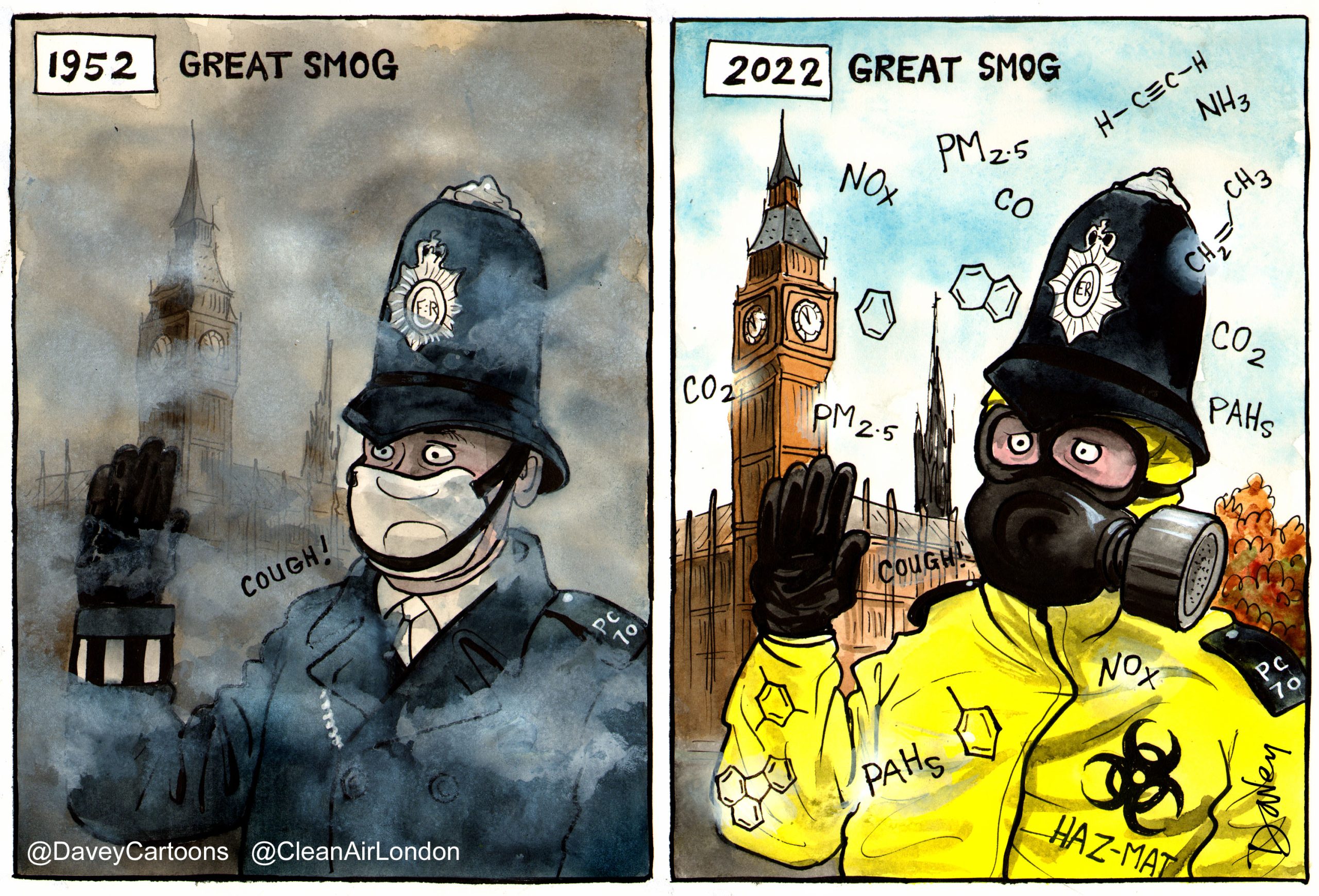
In the Great Smog of December 1952 there were 4,075 deaths in London due to short-term exposure to air pollution with more over the following months.  The number was easy to calculate through time-series analysis i.e. the number of deaths peaked about two days after air pollution levels peaked (and didn’t fall into a trough thereafter).  Epidemiologists say these people were ‘harvested’ – a disgusting word in this context.

The Committee on the Medical Effects of Air Pollutants (COMEAP) published a report in 1998 on the health impact of short-term exposure to PM10.  COMEAP estimated a total of 8,100 deaths ‘brought forward’ due to PM10 annually among total deaths in urban Great Britain (GB) (based on 1995 and 1996 air pollution levels).  The same COMEAP report referred to 3,500 deaths brought forward per year due to SO2 in urban areas of GB and between 700 and 12,500 deaths brought forward by O3 in both urban and rural GB during the summer only.

It was not until 1995 and 2000 that huge cohort studies (which followed a group of people over a period of time to determine the absolute risk of one or more health impacts) in cities in the United States with different annual mean concentrations of PM2.5 showed the health impact of long-term exposure to air pollution.  The results derived from the American Cancer Society (ACS) (Pope et al, 1995) and the Health Effects Institute (HEI) reanalysis of the ACS study and the US Six-Cities Study (HEI, 2000), which were subsequently confirmed on other continents and within cities, estimated a range of coefficients (i.e. hazard rates or relative risks) from 1% to 9% for a 10 microgram per cubic metre (ug/m3) reduction in PM2.5.

COMEAP reported on these results in 2001 that ‘using the 1% coefficient, the effects of long-term exposure were about ten-fold greater, on a years-of-life-lost basis (i.e. in terms of average life-shortening), than the effects of short-term exposure’.  Based on further scientific evidence, COMEAP in June 2009 recommended, as a best estimate for mortality in the UK, the higher risk coefficient of 6% change in risk of death from all causes with a 10 ug/m3 change in PM2.5 derived from the extension of the ACS study (Pope et al, 2002).  Oversimplifying, for population weighted exposure of 10 ug/m3 anthropogenic (man-made) and non-anthropogenic PM2.5 in a city with 50,000 deaths in a given year, this equates to 3,000 attributable deaths in a year.

Mayor Johnson was the first politician to use COMEAP’s 2009 advice to publish in June 2010 estimates by ward of 4,267 deaths in London in 2008 attributable to long-term exposure to PM2.5.  COMEAP lead the way nationally in December 2010 by estimating, using the language used for alcoholism, obesity and smoking, 29,000 deaths in the UK in 2008 attributable to long-term exposure to PM2.5 at an average loss of life for these people of about 11.5 years.  COMEAP and the Mayor’s estimates were calculated after eliminating the effect of dozens of other possible risk factors (e.g. educational status as a surrogate for income and smoking) to produce a pure number assuming air pollution is the sole cause of those deaths.  In CAL’s view, these estimates are much more meaningful to members of the public than ‘years of life lost’ or an ‘average loss of life of six months for everyone in the UK’.

The estimates of 4,267 and 29,000 extra or excess deaths are good ones for comparing the effects of air pollution with the effects of other causes such as alcohol, active or passive smoking, obesity, diet etc which are calculated in the same way.  However, COMEAP has shown us that because, in practice, individuals experience multiple risks, including air pollution, almost certainly air pollution played some part in shortening the life of a much larger number of individuals.  It is not possible to estimate that number reliably but, given that much of the impact of air pollution on mortality is linked to cardiovascular deaths, it is more reasonable to consider that air pollution may have contributed to all 200,000 deaths due to cardiovascular causes in the UK in 2008 (i.e. one in three of all deaths) at an average additional loss of life for these people of about two years (at typical ages for cardiovascular deaths e.g. 15% of which are before age 65).

Combining therefore the short and long-term impacts of different pollutants suggests a range of between 29,000 and 53,100 nationally if there is no overlap or 100% overlap between the health effects.  For the first time, we can compare easily the health impact of long-term exposure to PM2.5 with the Government’s estimates for the number of premature deaths attributable to alcoholism (15,000 to 20,000 in England; average men 20 years, women 15 years), obesity (9,000 in England; average nine years) and smoking (87,000 in England; average 10 years) and understand the complexities of these metrics.  There were 2,222 deaths from road traffic accidents in GB in 2009.

The health impact of air pollution is not just about mortality; it is also about morbidity i.e. illness.  Separate scientific research published by the Aphekom group of scientists in 2011 has shown that those living near roads travelled by 10,000 or more vehicles per day on average could be responsible for some 15-30 per cent of all new cases of asthma in children; and of COPD (chronic obstructive pulmonary disease) and CHD (coronary heart disease) in adults 65 years of age and older. The same study further estimated that, on average for all 10 cities studied, 15-30 per cent of exacerbations of asthma in children, acute worsening of COPD and acute CHD problems are attributable to air pollution. This burden is substantially larger than previous estimates of exacerbations of chronic diseases, since it has been ignored so far that air pollution may cause the underlying disease as well. Related research indicates that associations of asthma with traffic-related pollution from nearby sources at schools were independent of estimated effects of exposures at homes.  A Freedom of Information request to Transport for London by CAL has found 1,148 schools in London within 150 metres of roads carrying over 10,000 vehicles per day and a total of 2,270 within 400 metres of such roads.

Nor is the health impact of air pollution spread evenly across the population.  The EAC said “Preliminary results for England indicate that poor air quality is associated with areas of low income, low employment and lower education attainment, with differences in exposure to air pollution between different ethnic groups”.  CAL which saw these results, from work done by Imperial College’s highly respected Small Area Health Statistics Unit (SASHU), presented at the International Society for Environmental Epidemiology (ISEE) conference in Barcelona on 16 September 2011 recollects that the worst effected groups were exposed to up to 50% more NO2 than those least effected i.e. the health inequalities linked to combustion related air pollutants are up to twice those for PM10.  The research presented in Barcelona was titled “Associations between small area levels of air pollution and socio-economic characteristics in the Netherlands and England”.  A detailed for Defra in 2006 showed that inequalities are greater in areas with poorest air quality.  CAL has analysed marginal Parliamentary constituencies and zones breaching NO2 limit values.

In conclusion, it is fair to point out there were as many early deaths in London in 2008 due to long-term exposure to PM2.5 as we thought occurred during the Great Smog of 1952 (due to short-term exposure to air pollution when we knew nothing of the long-term effects).  Put another way: knowing that there were 4,000 early deaths in the Great Smog of 1952 was enough to ‘change the world’; but knowing there were 4,000 early deaths in London in 2008 is now considered by some ‘room for improvement’.

We must not let this ‘invisible’ public health crisis be ignored any longer.  Just because air pollution was visible in 1952 and the effects short-term, does not excuse ignoring the invisible, long-term effects now.  Who knows what further health risks the scientists will identify 10 years from now?  Officials should stop saying they’re worried about alarming people about the dangers of air pollution and start warning them.  It is a disgrace, for example, that it is much harder to find a list of cities and towns in the UK where NO2 diffusion tube data shows legal limits are breached than it was three or four years ago.  The Government should also be warning people that indoor air quality can be worse than outdoor and revising advice from 1998 on ‘tunnel dust’ in the London Underground.

The solutions are simple.  The Government should accept immediately and in full the recommendations of the two EAC reports.  In particular, it should implement a massive campaign on the scale of those for alcoholism and smoking to building public understanding of the dangers of air pollution with advice for people on protecting themselves and reducing pollution for themselves and others.  Some 90% of people at a conference on air quality in 2010 said they wanted to see an estimate for their local authority of the number of deaths attributable to long-term exposure to PM2.5 with advice on the careful interpretation of the information.

It’s time for change.  London and the UK should be leading the world in the Olympic year in tackling air pollution as we did after the Great Smog of 1952.

This is the first in a series of six articles being written for Politics Home by Simon Birkett, Founder and Director of Clean Air in London, about air quality in the lead up to the London 2012 Olympics.  Other topics are expected to include: legal issues; sources and solutions; Mayoral manifestos; indoor air quality; and the Olympics.

CAL 164_PH Full_110112


Posted in Health, Introduction, News | 1 Comment

Plans for Olympic Route Network and Paralympic Route Network remain unlawful and vulnerable to legal challenge through judicial review

The Transport Committee

Reply to the call for evidence submitted by:

Clean Air in London

26 February 2012

Transport plans for the 2012 Olympic and Paralympic Games

Introduction

The Transport Committee has invited written evidence on the transport plans (OTP) for the 2012 Olympic and Paralympic Games with a view to holding an oral evidence session.  Further details can be seen at:

http://www.parliament.uk/business/committees/committees-a-z/commons-select/transport-committee/news/olympics—tor/

Clean Air in London (CAL) is pleased to respond to this call for evidence.  CAL is a not for profit organisation with a mission that includes campaigning to achieve urgently and sustainably compliance with World Health Organisation (WHO) guidelines for air quality throughout London.

CAL is independent of any government funding, has cross-party support and many supporters, both individuals in London and organisations.  CAL provides a channel for both public concern and expert opinion on air pollution in London.  This document provides both general and expert comments in response to the call for evidence.  Further details about CAL can be seen at: http://www.cleanairinlondon.org/

CAL is keen to give oral evidence to the Transport Committee about the risk that the Olympic Route Network (ORN) will cause breaches of air quality laws in London and make recommendations.

Executive summary

This submission relates primarily to the ORN.  It summarises the key health impacts of poor air quality and legal issues most relevant to the OTP.

It highlights the legal requirements to ensure: the particulate matter (PM10) daily and annual mean limit values are not exceeded in London (or elsewhere) in 2012 (e.g. no more than 35 ‘Bad Air Days’ when 12 have been reported already along the ORN at Upper Thames Street); the nitrogen dioxide (NO2) hourly and annual mean limit values are not to be exceeded where they have previously been attained (e.g. in nearby roads); and NO2 levels are not worsened by the OTP and/or ORN where levels of air pollution are currently breaching legal limits (e.g. along much of the ORN in central London).

It highlights admissions in the Strategic Environmental Assessment (SEA) of the Olympic Transport Plan in February 2011 that air quality laws were expected to be breached as a result of the OTP.  Also repeated assurances from Transport for London (TfL) since October 2011 that an up to date analysis of the environmental impacts of the ORN would be provided to CAL together with details of mitigation measures.  These are still awaited.

Separately, CAL has urged the European Commission (Commission) to launch infraction action against the UK well before the Olympics for breaching the PM10 daily limit value and the NO2 annual mean and hourly limit values in London including along the ORN in earlier years.

This submission makes recommendations for the mitigation of air pollution during the Games.

Health impacts of poor air quality

Ambient or outdoor air pollution comprises particles and gases.  The particles, which can comprise anything from tiny droplets to diesel soot and tyre and brake wear, are called ‘particulate matter’ and classified by their aerodynamic diameter in microns (one-millionth of a metre (mm) which is about one-hundredth of the thickness of a human hair) e.g. PM2.5 and PM10.  The gases, which can coalesce and become particles, are mainly NO2, ozone (O3) and sulphur dioxide (SO2).

The WHO says there is little evidence to suggest a threshold below which no adverse health effects would be anticipated for particulate matter or, put another way, there is no safe level of human exposure to it.  NO2 is a product of combustion processes and is generally found in the atmosphere in close association with other primary pollutants, including ultrafine particles.  NO2 is not ‘just’ a molecule.

In the Great Smog of December 1952 there were 4,075 deaths in London due to short-term exposure to air pollution with more over the following months.  The number was easy to calculate through time-series analysis i.e. the number of deaths peaked about two days after air pollution levels peaked (and didn’t fall into a trough thereafter).

It was not until 1995 and 2000 that huge cohort studies (which followed a group of people over a period of time to determine the absolute risk of one or more health impacts) in cities in the United States with different annual mean concentrations of PM2.5 showed the health impact of long-term exposure to air pollution.

Mayor Johnson was the first politician to use advice from the Committee on the Medical Effects of Air Pollution (COMEAP) in 2009 to publish in June 2010 estimates by ward of 4,267 deaths in London in 2008 attributable to long-term exposure to PM2.5.  COMEAP lead the way nationally in December 2010 by estimating, using the language used for alcoholism, obesity and smoking, 29,000 deaths in the UK in 2008 attributable to long-term exposure to PM2.5 at an average loss of life for these people of about 11.5 years.  COMEAP and the Mayor’s estimates were calculated after eliminating the effect of dozens of other possible risk factors (e.g. educational status as a surrogate for income and smoking) to produce a pure number assuming air pollution is the sole cause of those deaths.

It is fair to point out there were as many early deaths in London in 2008 attributable to long-term exposure to PM2.5 as we thought occurred during the Great Smog of 1952 (due to short-term exposure to air pollution when we knew nothing of the long-term effects).

Separately, top UK lung scientists are warning that a “Summer Smog”, like August 2003 or July 2006, could affect Olympic athletes this summer.  See The Independent on 16 January 2012:

http://www.independent.co.uk/environment/climate-change/polluted-air-puts-olympic-athletes-at-risk-6290216.html

These scientists were reported as saying that if we have still hot days, long distance athletes, like marathon runners and cyclists who breathe very hard, could feel a tightness in their chest or experience ‘coughs, breathlessness or other problems’.  Those with asthma may need medication.  Athletic performance could be affected.

It is not just about Olympic athletes though.  In the “Summer Smog” of 2003, the Government estimated 46 to 212 early deaths in London attributable to ozone and 85 attributable to short-term exposure to PM10.

Beijing has much higher levels of airborne particles than London but London has the highest levels of NO2 of all 27 capital cities in Europe and levels comparable with those in Beijing before it took action to ensure the success of the 2008 Olympics.

The Mayor of London estimated in his Air Quality Strategy that road transport contributed around 80% of PM2.5 emissions in London in 2008 (page 41).

Air quality laws

Air quality laws are breached every day by a factor or two or more along London’s busiest roads (and elsewhere) including along the ORN.  No other public health or environmental standard is breached on such a large scale with such serious consequences for public health.

CAL has therefore lodged a formal complaint with the Commission about the UK’s failure to comply with air quality laws.  ‘Part one’ of the Complaint is that: the UK obtained unlawfully a time extension to comply with the daily limit value for PM10 in London; and, without prejudice to that part of the Complaint, even if a time extension is sustained for the PM10 daily limit value, it was breached in Neasden Lane, London (again) in 2011.  ‘Part two’ of the Complaint is that: the UK breached the annual mean and hourly limit values for NO2 in London and 16 other zones in 2010 (and 2011); and has not applied for a time extension for those zones (i.e. it submitted: plans for 23 zones in September 2011 under Article 22 of Directive 2008/50/EC on ambient air quality and cleaner air for Europe; and plans for London and 16 other zones under Article 23).  The Commission has said it may consider the complaint as part of an EU Pilot which would aim to reach a decision within 10 weeks.

These are not new laws.  An Air Quality Framework Directive (Council Directive 1996/62/EC), covering ambient air quality assessment and management, entered legislation in 1996.  It was followed in 1999 by a so-called First Daughter Directive (Council Directive 1999/30/EC) which set limit values for various pollutants including NO2 and PM10 and thresholds for assessing and managing air quality for the pollutants concerned.   Since 1999 therefore, limit values to be attained and not exceeded have been: an annual mean of 40 ug/m3 and not more than 35 days over 50 ug/m3 for PM10 from 1 January 2005; and an annual mean of 40 ug/m3 and not more than 18 hours over 200 ug/m3 for NO2 from 1 January 2010.  In other words, the legal limits for PM10 are up to twice WHO guidelines whereas those for NO2 are aligned with WHO guidelines.

Directive 2008/50/EC entered into force on 11 June 2008.  Amongst other things, it set new standards for fine particles (PM2.5)to be achieved by 2015 and 2020 and allowed Member States to apply for a time extension to comply with limit values for PM10 and NO2.  Time extensions can only be obtained if a Member State meets strict conditions including demonstrating that compliance with the limit values will be achieved by the new deadline.  The latest deadline possible for PM10 was 11 June 2011.  After two failed attempts to obtain a time extension, the UK obtained unlawfully a time extension until 11 June 2011 to comply with the PM10 daily limit value in London after submitting an updated air quality plan to the Commission without consulting the public on it.  The good news for public health is that no further time extension or breach of the PM10 annual and daily limit values is allowed in London (or elsewhere).

The latest deadline possible for NO2 is 1 January 2015.  The Government has said it can’t (or won’t) comply with the NO2 limit values in London until 2025 and so is unable to meet a basic condition of a time extension i.e. to demonstrate compliance by no later than 1 January 2015.  In fact, Mayor Johnson listed 14 measures in his Air Quality Strategy published in 2010 to show that the NO2 limit values could be complied with by 2015 if Government support was forthcoming.  Even if a time extension for NO2 were to be obtained in future, another requirement of Directive 2008/50/EC is that the limit value plus margin of tolerance must not be exceeded during the period of a time extension i.e. an annual mean of 60 mg/m3 and no more than 18 hours over 300 mg/m3.  Annex III of Directive 2008/50/EC emphasises that limit values apply everywhere in ambient air unless: the public do not have access; or all relevant provisions concerning health and safety at work apply.

Air quality laws can be enforced by the Court of Justice of the European Union (CJEU) and in the UK Courts.  The former involves the European Commission in a five stage legal (or infraction) process: (i) Letter of Formal Notice (first written warning); (ii) Reasoned Opinion (second and/or final written warning which the UK had reached for PM10 before it obtained a time extension in 2011); (iii) reference to the CJEU requesting a judgement that the Member State is in breach and must comply; (iv) Letter of Formal Notice; and (v) reference to the CJEU requesting the imposition on the Member State of lump sum and daily fines.  The Mayor of London has estimated that such fines, which could be passed to London under the Localism Act 2011, could total £300 million per year for each of PM10 and NO2.  CAL considers that fines (or gaol) are a necessary final sanction in any legal system.

CAL has urged the Commission to launch infraction action against the UK well before the Olympics for breaching the PM10 daily limit value and the NO2 annual mean and hourly limit values in London including along the ORN in earlier years.

Specific legal situation for Olympic Route Network

We were promised the ‘greenest Games ever’.  For details please refer to a letter from the Campaign for Clean Air in London to The Rt. Hon. Tessa Jowell MP dated 17 January 2008.

All this matters for London and the Olympics since limit values must not be exceeded once attained and air pollution may not be worsened where limit values are already breached.  CAL has sought assurances about the impact of the Olympic Route Network after the Strategic Environmental Assessment for the Olympic Transport Plan admitted in February 2011 “However, the number of daily mean exceedances at some roadside sites is anticipated to be more than the allowable number of exceedances.”  Further details were set out in a letter dated 11 April 2011 to the ODA and Mayor Johnson titled ‘Consultation shows Olympic Transport Plan would lead to breaches of air pollution laws’.

CAL wrote again to Mayor Johnson, as Chairman of Transport for London, in a letter dated 12 September 2011 titled ‘Plans for Olympic Route Network and Paralympic Route Network remain unlawful and vulnerable to legal challenge through judicial review’.

CAL has exchanged several letters with TfL since then dated 18 October, 8 December and 21 December (from TfL) and 8 November and 12 December (from CAL).  CAL would be pleased to share those letters with the Transport Committee.  In essence, TfL has promised in each letter since last October to provide CAL with details of the environmental impacts of the ORN and the mitigation of them. These are still awaited.

The Mayor of London told Val Shawcross AM (Labour) in a written response 3007/2011 dated 12 October 2011 that “TfL (with Kings College) is currently modelling the potential implications for air quality. Previous emissions analysis was undertaken based on an early iteration of the ODA?s traffic modelling, but it was not possible to model the more detailed air quality impacts prior to more detailed design of the routes and associated traffic management.”  For details, please see:

http://mqt.london.gov.uk/mqt/public/question.do?id=37933

King’s College London did similar analysis assessing the impact of the removal of the western extension of the congestion charging zone in 2010.

According to the excellent London Air Quality Network at www.londonair.org.uk, which is run by King’s College London, the number of ‘Bad Air Days’ along the ORN in Upper Thames Street and Marylebone Road as at 26 February 2012 is 12 and 11 respectively (with six recorded by the ‘FDMS’ monitor at Marylebone Road).  So far in Brompton Road, there have been 61 exceedances of the NO2 hourly limit value and the NO2 mean is 89 ug/m3.  Details can be seen at:

http://www.londonair.org.uk/london/asp/advstatsaqobjresults.asp?site1=CT8&site2=KC3&site3=MY1&site4=MY7&sday=1&smonth=jan&syear=2012&Submit=View

By 26 February 2011 there had been five Bad Air Days at Upper Thames Street and 15 in Marylebone Road (with 14 recorded by the FDMS monitor at Marylebone Road).

http://www.londonair.org.uk/london/asp/advstatsvariousresults.asp?site1=CT8&site2=MY1&site3=MY7&site4=&stattype=xcreadings&xvalue=50&zunits=none&startdate=01-01-2011&enddate=26-02-2011&submit=View&period=dailymean&species=PM10

In 2011, the PM10 daily limit value was breached in Marylebone Road by 20 April.  Please see:

http://www.londonair.org.uk/london/asp/advstatsvariousresults.asp?site1=CT8&site2=MY1&site3=MY7&site4=&stattype=xcreadings&xvalue=50&zunits=none&startdate=01-01-2011&enddate=20-04-2011&submit=View&period=dailymean&species=PM10

This section highlights the legal requirements to ensure: the PM10 daily and annual mean limit values are not exceeded in London (or elsewhere) in 2012 (e.g. no more than 35 ‘Bad Air Days’ when 12 have been reported already along the ORN at Upper Thames Street); the NO2 hourly and annual mean limit values are not to be exceeded where they have previously been attained (e.g. in nearby roads); and NO2 levels are not worsened by the OTP and/or ORN where levels of air pollution are currently breaching legal limits (e.g. along much of the ORN in central London).

Mitigation measures

Olympic Travel Demand Management (TDM) measures typically include: travel capacity creation measures; travel behaviour change/marketing; traffic efficiency measures; traffic bans; and an emphasis on public transport.

Travel behaviour change/marketing measures seek to manage expectations as part of Olympic transport planning and use the ‘Big Scare’ to influence travel behaviour.  The ‘Big Scare’ refers to the concerns which Games city residents have about travel and living conditions during Games time.  It was first used to influence demand during the Sydney 2000 Games.

Page 87 of the SEA stated:

“Overall, it has been estimated that the Games will lead to a nearly 30% reduction in traffic flows on the ORN and PRN and about five per cent additional road traffic elsewhere, although it should be noted that this is at a time of year where traffic levels, particularly in London, are typically lower than average.

“In addition, evidence from the Sydney 2000 Games indicates that there was also a reduction in background travel demand during the period of the Olympic Games and Paralympic Games. It has been noted in this respect that ‘a successful travel demand management programme (TDM) … resulted in a notable decrease of background travel in Sydney during the Games.  This was largely achieved through a patient and well-orientated pre-Games communications campaign, aimed at citizens, potentially affected residents, local commerce and large businesses’.  Such demand management will also be a feature of the London 2012 Transport Plan.  On this basis, therefore it is not anticipated that there would be an overall increase in traffic flows and vehicle kilometres during the period that the Transport Plan is operational.” CAL emphasis.

CAL understands that a 30% reduction in non-Games Family traffic would be exceptional during the Olympic Games.  In any event, because it depends on the use of the ‘Big Scare’ to manage people’s expectations such reductions are unlikely to be achieved in London given the ‘cat is out of the bag’.  Some sort of large scale traffic bans or restrictions therefore seem inevitable for London.  Beijing and Athens both imposed ‘odd and even’ number plate bans.

At the moment, it seems Mayor Johnson’s plan is to use dust suppressants on roads in front of official air quality monitors during the Olympic and Paralympic Games to reduce local air pollution and ensure compliance with the PM10 daily limit value in London.  Even this approach, which would humiliate London in front of the world’s media, would do nothing to ensure compliance with NO2 limit values or avoid the worsening of unlawful levels of air pollution.  It seems there is no convincing plan yet to ensure the Olympic Transport Plan and ORN in particular will not cause breaches of air quality laws.

Recommendations for action

The Games should be a catalyst for long-term improvement in air quality so, for the duration of the Olympic and Paralympic Games and with a planned legacy, the Mayor should:

  •  Introduce a strict low emission zone or ‘Clean Air Zone’ that bans the most polluting heavy and light diesel vehicles from the most polluted parts of London.  CAL has called for such action for years.  The alternative is an ‘odd and even’ number plate ban which would affect all drivers equally e.g. including zero tailpipe emission vehicles; and
  • Develop a contingency strategy detailing short-term measures to be taken if air quality standards (e.g. Bad Air Days) are likely to be exceeded during the Games period or 2012.

CAL considers alerts and/or public warnings should also be given where smog episodes occur.

Close

CAL considers that London should be leading the world in tackling air pollution as it did after the Great Smog of 1952.  Currently, this looks unlikely.

CAL 170 TSC Olympic Transport Plans 260212

CAL 166 TfL ORN air-quality-report-March 2012

CAL 166 Update Olympics 160112

CAL 166 Nitrogen dioxide_Beijing London Olympics_Draft 130112

CAL 166 Road PM Monitoring Data 2001 to 2011_050112

CAL 173 Dust suppressants per MAQS p76

CAL 134 Letter to ODA and TfL re ORN 080411 V2

CAL 147 Letter to TfL re ORN 120911

CAL 032 Letter 170108

CAL 032 Monash Big Scare

CAL 050 Monash Big Scare 2


Posted in Olympics | Leave a comment

Legal: UK is cheating on air quality laws and misleading the European Commission

Air quality laws are breached every day by a factor or two or more along London’s busiest roads (and elsewhere).  No other public health or environmental standard is breached on such a large scale with such serious consequences for public health.

Clean Air in London (CAL) has therefore lodged a formal complaint with the European Commission (Commission) about the UK’s failure to comply with air quality laws.  ‘Part one’ of the Complaint is that: the UK obtained unlawfully a time extension to comply with the daily limit value for dangerous airborne particles (PM10) in London; and, without prejudice to that part of the Complaint, even if a time extension is sustained for the PM10 daily limit value, it was breached in Neasden Lane, London (again) in 2011.  ‘Part two’ of the Complaint is that: the UK breached the annual mean and hourly limit values for nitrogen dioxide (NO2) in London and 16 other zones in 2010 (and 2011); and has not applied for a time extension for those zones (i.e. it submitted: plans for 23 zones in September 2011 under Article 22 of Directive 2008/50/EC on ambient air quality and cleaner air for Europe; and plans for London and 16 other zones under Article 23).

These are not new laws.  An Air Quality Framework Directive (Council Directive 1996/62/EC), covering ambient air quality assessment and management, entered legislation in 1996.  It was followed in 1999 by a so-called First Daughter Directive (Council Directive 1999/30/EC) which set limit values for various pollutants including NO2 and PM10 and thresholds for assessing and managing air quality for the pollutants concerned.   Since 1999 therefore, limit values to be attained and not exceeded have been: an annual mean of 40 ug/m3 and not more than 35 days over 50 ug/m3 for PM10 from 1 January 2005; and an annual mean of 40 ug/m3 and not more than 18 hours over 200 ug/m3 for NO2 from 1 January 2010.  In other words, the legal limits for PM10 are up to twice World Health Organisation (WHO) guidelines whereas those for NO2 are aligned with WHO guidelines.

Directive 2008/50/EC entered into force on 11 June 2008.  Amongst other things, it set new standards for fine particles (PM2.5)to be achieved by 2015 and 2020 and allowed Member States to apply for a time extension to comply with limit values for PM10 and NO2.  Time extensions can only be obtained if a Member State meets strict conditions including demonstrating that compliance with the limit values will be achieved by the new deadline.  The latest deadline possible for PM10 was 11 June 2011.  After two failed attempts to obtain a time extension, the UK obtained unlawfully a time extension until 11 June 2011 to comply with the PM10 daily limit value in London after submitting an updated air quality plan to the Commission without consulting the public on it.  The good news for public health is that no further time extension or breach of the PM10 annual and daily limit values is allowed in London (or elsewhere).

The latest deadline possible for NO2 is 1 January 2015.  The Government has said it can’t (or won’t) comply with the NO2 limit values in London until 2025 and so is unable to meet a basic condition of a time extension i.e. to demonstrate compliance by no later than 1 January 2015.  In fact, Mayor Johnson listed 14 measures in his Air Quality Strategy published in 2010 to show that the NO2 limit values could be complied with by 2015 if Government support was forthcoming.  Even if a time extension for NO2 were to be obtained in future, another requirement of Directive 2008/50/EC is that the limit value plus margin of tolerance must not be exceeded during the period of a time extension i.e. an annual mean of 60 ug/m3 and no more than 18 hours over 300 ug/m3.  Annex III of Directive 2008/50/EC emphasises that limit values apply everywhere in ambient air unless: the public do not have access; or all relevant provisions concerning health and safety at work apply.

Other legal standards exist for pollutants such as benzene, carbon monoxide, lead and sulphur dioxide and there are targets for ozone.  Directive 2008/50/EC introduced legal standards for fine particles (PM2.5): an annual mean of 25 ug/m3 to become a limit value on 1 January 2015; a 20 ug/m3 exposure concentration obligation in 2015; and an exposure reduction target in percentage terms by 2020.

Air quality laws can be enforced by the Court of Justice of the European Union (CJEU) and in the UK Courts.  The former involves the European Commission in a five stage legal (or infraction) process: (i) Letter of Formal Notice (first written warning); (ii) Reasoned Opinion (second and/or final written warning which the UK had reached for PM10 before it obtained a time extension in 2011); (iii) reference to the CJEU requesting a judgement that the Member State is in breach and must comply; (iv) Letter of Formal Notice; and (v) reference to the CJEU requesting the imposition on the Member State of lump sum and daily fines.  The Mayor of London has estimated that such fines, which could be passed to London under the Localism Act 2011, could total £300 million per year for each of PM10 and NO2.  CAL considers that fines (or gaol) are a necessary final sanction in any legal system.

In the UK Courts, ClientEarth sought a judicial review of the UK’s failure to demonstrate compliance with the NO2 limit values by 1 January 2015.  Mr Justice Mitting in the High Court ruled on 13 December 2011 that:

‘It is now common ground that the United Kingdom is in breach of its obligations [for NO2] under Article 13.  It is not necessary for me to declare that that is so.  This judgment records the Secretary of State’s concession and my view about the correctness of that concession.  A declaration will serve no purpose other than to make clear that which is already conceded.  The means of enforcing Article 13 lie elsewhere in the hands of the Commission under article 258 of the Treaty on the Functioning of the European Union, and if referred to it, the Court of Justice of the European Union under Article 260.  Those remedies are sufficient to deal with the mischief at which the 2008 Directive is aimed.’ 

In CAL’s view, this judgement was not consistent with Article 30 of Directive 2008/50/EC which says Member States shall lay down the rules on penalties applicable to infringements of the national provisions adopted pursuant to this Directive and shall take all measures necessary to ensure that they are implemented. The penalties provided for must be effective, proportionate and dissuasive.’  ClientEarth is understood to be seeking leave to appeal this judgement to the Court of Appeal.

For those seeking compliance with ambient air quality laws, important other provisions exist in: the Clean Air Act 1993; Policy 7.14 of the London Plan; and the Air Quality Standards Regulations 2010.

All this matters for London and the Olympics since limit values must not be exceeded once attained and air pollution may not be worsened where limit values are already breached.  CAL has sought assurances about the impact of the Olympic Route Network after the Strategic Environmental Assessment for the Olympic Transport Plan admitted in April 2011 “However, the number of daily mean exceedances at some roadside sites is anticipated to be more than the allowable number of exceedances.”  Transport for London has promised several times since last October to provide CAL with details of the environmental impacts and the mitigation of them but these are still awaited.  At the moment, it looks like Mayor Johnson’s plan is to use dust suppressants on roads in front of official air quality monitors during the Olympic and Paralympic Games to reduce local air pollution and ensure compliance with the PM10 daily limit value in London.  Even this fraudulent approach would do nothing to ensure compliance with NO2 limit values.

The UK’s actions and failures to date give a clear indication of how it is likely to behave when revisions to air quality legislation are considered in 2013 and beyond.  Article 32 of Directive 2008/50/EC requires ‘In 2013, the Commission shall review the provisions related to PM2.5 and, as appropriate, other pollutants and shall present a proposal to the European Parliament and the Council’.  The Commission has said it is reviewing also the National Emissions Ceilings Directive and plans a ‘Year of Air’ in 2013.  CAL’s response to the Commission’s consultation emphasised the need for robust enforcement of current legislation and continuity and the further tightening of health and legal protections.  The Government is suggesting the ‘simplification’ of the current air quality regime by: only having targets where action is needed; minimising the number of targets per pollutant (e.g. only one?); the review of the zonal approach for reporting; and reducing the ‘complexity’ of the reporting framework.  The Government is also seeking to undermine the legal standards for PM2.5 rather than suggesting better ways to enforce them.  CAL understands that the Government and the Mayor of London are seeking ‘flexibility’ in the legal requirements.  CAL strongly opposes such an approach since there is no chance the authorities will comply with flexible obligations having failed to comply with strict ones.   In any event, with elections for the European Parliament due in May 2014, it seems unlikely that any changes would enter legislation before 2015 or 2016 at the earliest.

It is totally unacceptable that the UK is cheating on air quality laws and misleading the Commission.  Clean Air in London urges the Commission to ‘throw the rule book’ at the UK and London well before the Olympics.

This is the second in a series of six articles being written for Politics Home by Simon Birkett, Founder and Director of Clean Air in London, about air quality in the lead up to the London 2012 Olympics. The first article was titled ‘Invisible’ air pollution: the biggest public health failing or ‘cover-up’ for decades.  Other topics are expected to include: sources, solutions and opportunities; Mayoral manifestos; indoor air quality; and the Olympics.

CAL 169_PH Full 2_220212

CAL 149 Letter on RTC Clean Air Act 210911

CAL 124 WEZ expert report 120312

CAL 081 Response to AQSR 2010 consultation etc 280110

CAL 124 Update re WEZ LBA 190111

CAL 153 Update re London Plan 151011 V2

CAL 160 Update re Court of Appeal decision 211211 V2

CAL 131 Heather Brookes template for FoI and EIR requests 230211


Posted in Introduction, Legal | Leave a comment

‘Clean Air in London’ calls on all the Mayoral candidates to promise in their manifestos to end the biggest public health crisis for decades

‘Clean Air in London’ calls on all the Mayoral candidates to promise in their manifestos to end the biggest public health crisis for decades

We need a Mayor who will: Lead the fight to improve London’s air; Clean up London’s transport; Build a low emission city; Protect the most vulnerable; and Ensure a legacy from the Olympic Games

Clean Air in London intends to rank Mayoral candidates on their commitment to measures in this manifesto before the Mayoral election

London should lead the world in tackling air pollution as it did after the Great Smog of 1952

Clean Air in London, which runs the cross-party campaign of the same name, has published its manifesto for the Mayoral and London Assembly elections on 3 May 2012.

Simon Birkett, Founder and Director of Clean Air in London, said:

“London is back where we thought it was during the Great Smog of 1952.

“Boris Johnson says there were 4,267 early deaths in London in 2008 attributable to long-term exposure to ‘invisible’ air pollution (at an average of 11.5 years each).  This compares to 4,075 due to short-term exposure during the ‘visible’ Great Smog of 1952 when we knew nothing of the health impact of long-term exposure to air pollution.  Only smoking causes more early deaths now.

“The Mayor must protect the health of Londoners and ensure full compliance with UK and European air quality laws throughout London.  We need a Mayor who will:

  • Lead the fight to improve London’s air by championing the tightening of health and legal protections, ensuring good governance and improving public understanding of poor air quality
  • Clean up London’s transport by reducing traffic emissions, cleaning up the public transport system, reducing emissions from non-road mobile machinery and supporting active travel
  • Build a low emission city by using planning powers and other opportunities to reduce emissions from buildings and improve indoor air quality
  • Protect the most vulnerable through a focus on children, the elderly, the poor and ethnic minorities
  • Ensure a legacy from the Olympic Games by delivering a low emission Olympics and more

“Clean Air in London is therefore calling on all the Mayoral candidates to promise in their manifestos to end the biggest public health crisis for decades.  After four years of backward steps on air quality measures, Boris is well behind on this issue.

“We need a Mayor who will show the world, starting with the Olympics, that London is leading the way in tackling air pollution as it did after the Great Smog of 1952.”

Notes:

  1. Titled ‘Manifesto for ‘clean air in London’’, the manifesto lists five themes, 12 key policy areas and 45 measures needing to taken by the Mayor and London Assembly over the next four years.
  2. Kulveer Ranger, the Mayor’s Director of Environment and Digital London, is due to give evidence on 2 February 2012 to the London Assembly Environment Committee about key environmental priorities for London over the coming years

http://www.london.gov.uk/media/press_releases_london_assembly/week-ahead-london-assembly-74

CAL 167 Manifesto 020212

CAL 167 Manifesto for the Mayoral and London Assembly elections 2012_Final 020212_V2

CAL 062 010509 Sixty five recommendations from CCAL to improve air quality in London

CAL 074 NOx transect across London

CAL 069 Defra Racial Equality Impact Assessment for PM10 140809

CAL 140 Central and inner London LEZ feasibility study

CAL 145 Fumifugium_MMXI

CAL 152 TSC Shipping 111011 V3

CAL 162 2_Lutz-LEZ-Jun09-EN-fin__Compatibility_Mode_

CAL 162 LEZ-VO-Impact-Assessment-May-2010 Page 44 tonnes in 2010

CAL 062 Every breath you take by LAEC 010509

CAL 074 Edward Townes graphs


Posted in Mayoral election, News, Solutions | 4 Comments

Camfil Farr UK becomes the first Gold Sponsor of Clean Air in London


Camfil Farr UK becomes the first Gold Sponsor of Clean Air in London

New campaign to build public understanding of the dangers of indoor air quality, initially in London, with advice for people on protecting themselves and reducing pollution

Camfil Farr in the UK has become the first Gold Sponsor of Clean Air in London (CAL).

Camfil Farr is also supporting a new campaign by CAL to build public understanding of indoor air quality (IAQ), initially in London, with advice for people on protecting themselves (adaptation) and reducing pollution for themselves and others (mitigation).

IAQ can be worse than outdoor (i.e. ambient) air quality (AAQ).  Without filters, up to 50% (and much more in some cases) of air pollution found indoors comes from outside.  IAQ can be further affected by: tobacco smoke from indoor smoking; combustion (such as gas cooking or candles); water systems, leaks and condensation; and substances emitted from some building materials, furnishings and cleaning agents Note 1.  According to the Mayor of London, domestic gas combustion (e.g. from cooking and heating) in turn contributed 22% to ambient air emissions of oxides of nitrogen (NOx) in Greater London in 2008 Note 2.  IAQ can be improved by particle filters and/or molecular filters which largely eliminate harmful particles and gases respectively.  Today’s European citizens spend – on average – over 90% of their time indoors Note 1.

Camfil Farr and CAL agree that clean air is a human right.  The sponsorship is based on mutual respect and is backed by an explicit agreement that CAL can speak without ‘fear or favour’.  Camfil Farr has made clear to CAL its commitment to the banning of smoking in buildings.

As part of this sponsorship CAL will provide a minimum number of days of advisory services to Camfil Farr each year.  The sponsorship will be disclosed on CAL’s website and further brought to the attention of relevant parties if either CAL or Camfil Farr considers a conflict of interest might be perceived.

Further announcements are expected in coming months.

Quotes

Bill Wilkinson, Managing Director of Camfil Farr in the UK, said:

Camfil Farr believes that Clean Air is a human right and so we design high quality filtration solutions that meet the needs of sustainable ventilation by creating the right balance between healthy indoor air and energy savings.  We welcome the opportunity to work with Clean Air in London to highlight the issues surrounding indoor air quality, air pollution and its effect on human health.”

Simon Birkett, Founder and Director of Clean Air in London, said:

“It has been marvellous to get to know Camfil Farr with its passion for clean air.  With Camfil Farr’s support, CAL is able to launch a much needed and exciting new campaign to warn people of the dangers of poor indoor air quality and press for further legal standards to protect people in public buildings.  As Clean Air in London’s first sponsor, Camfil Farr’s financial support will also aid the sustainability of Clean Air in London.”

Contacts:

Bill Wilkinson, Managing Director of Camfil Ltd.

Telephone: +44 1706 238 000

Simon Birkett, Founder and Director of Clean Air in London

Notes

EnVIE report for the European Commission titled ‘Co-ordination Action on Indoor Air Quality and Health Effects’ published in February 2009.

http://www.envie-iaq.eu/documents/finalreports/Final%20Reports%20Publishable/Publishable%20final%20activity%20report.pdf

Mayor’s Air Quality Strategy (see page 43)

http://www.london.gov.uk/sites/default/files/Air%20Quality%20Strategy%20v3.pdf

World Health Organisation guidelines for indoor air quality

Selected pollutants published in 2010:

http://www.euro.who.int/en/what-we-publish/abstracts/who-guidelines-for-indoor-air-quality-selected-pollutants

Dampness and mould published in 2009:

http://www.euro.who.int/en/what-we-publish/abstracts/who-guidelines-for-indoor-air-quality-dampness-and-mould

Camfil Ltd is the UK subsidiary of Camfil AB which trades as Camfil Farr or the Camfil Farr Group.  Camfil Farr is a world leader in the development and production of air filters and clean air solutions.  Camfil Farr is also one of the most global air filtration specialists in the world with 23 production units and research and development centres in four countries in the Americas, Europe and the Asia-Pacific region.

Camfil Farr, headquartered in Stockholm, Sweden, has approximately 3,350 employees and sales in the region of SEK 4.6 billion (c. £440 million).  International markets account for almost 90% of sales.

The company’s business is to provide customers with sustainable best-in class air filtration products and services within four main segments: Comfort Air; Clean Processes; Power Systems; and Safety and Protection.

With 47 years of experience in air filtration products and solutions, Camfil Farr delivers value to customers all over the world while contributing to something essential to everyone – clean air for health, wellbeing and performance.

See: www.camfilfarr.com www.camfilfarr.co.uk and www.camfilfarr.co.uk/filter-technology

Clean Air in London is responsible for the Campaign for Clean Air in London which was established in 2006.  Its aims include establishing, sponsoring, supporting and/or managing campaigns or other activities with the aim of achieving urgently and sustainably at least World Health Organisation recommended standards of air quality throughout one or more cities.

Further details can be seen at www.cleanairinlondon.org

CF Road Show 131011_Final_131011


Posted in Indoor air quality, News | Leave a comment